As 2025 dawns, email segmentation is establishing itself as an essential weapon for seasoned marketers. Far from mass, impersonal sending, the trend is toward ultra-targeted, personalized communication, fueled by precise behavioral data and a fine command of audience targeting. Email marketing is evolving toward intelligent automation where each message resonates exactly with the needs and maturity of the recipient. Thus, understanding the new levers for segmenting your email list effectively becomes a strategic challenge for improving the open rate, strengthening customer engagement, and boosting the overall performance of campaigns. This evolution is part of a digital context where attention is scarce, while requirements regarding consent and GDPR compliance remain more than ever at the heart of the relationship. In this shifting environment, the challenge is to adopt segmentation that combines simplicity, relevance, and scalability, using both interest tags, personas, and behavioral triggers, and relying on ready-to-use scenarios that accelerate conversion.
Opting for suitable segmentation doesn’t just mean dividing your database into small groups, but above all transforming your email database into a genuine machine for delivering the right experience at the right time. This approach not only improves key indicators such as the open rate, but also optimizes the customer relationship by creating rich, personalized exchanges. Finally, it’s a pragmatic approach where regular KPI analysis, running A/B tests, and maintaining cleanly qualified data are essential pillars. Getting started with these advanced strategies, integrated into high-performing tools like Peachie, allows you to gain efficiency while respecting the new standards of digital communication in 2025.
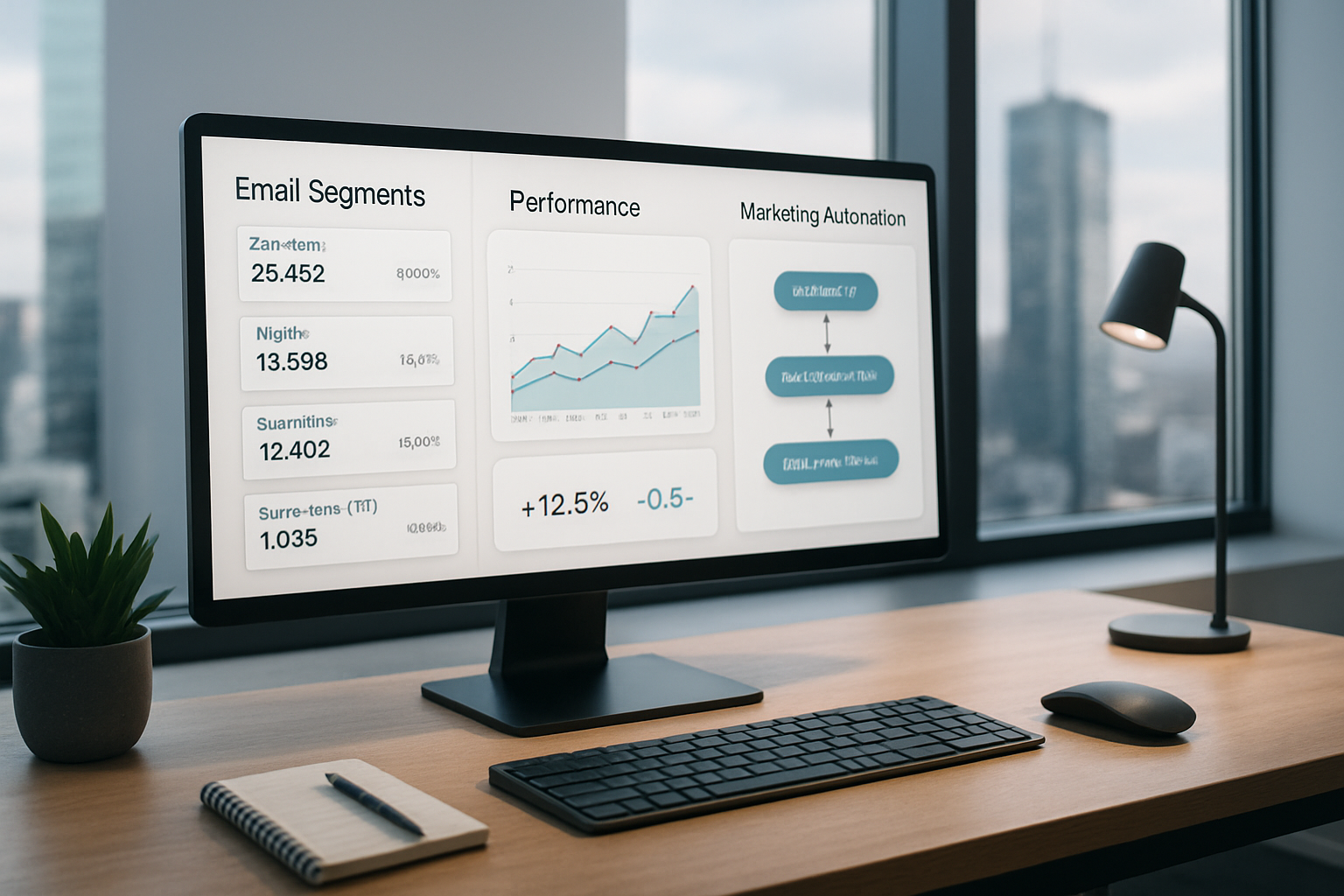
Why email segmentation is the key to success in email marketing
Sending the same message to an entire email list, whatever its size, is a costly mistake. Email segmentation is the secret to transforming mass sends into personalized, engaging conversations. In 2025, this methodology has become essential to avoid audience saturation and maximize ROI. It addresses a dual challenge: improving the perceived relevance for each contact and ensuring that every communication fits into a coherent journey.
The concrete advantages of segmentation include:
- Stronger open rate: A targeted message captures attention more easily, particularly when email personalization is advanced.
- Increased customer engagement: Tailored content promotes clicks, conversion, and the establishment of a lasting relationship.
- Reduced unsubscribe rate: By avoiding sending irrelevant content, you limit recipient fatigue.
- Optimization of resources: Campaign effectiveness translates into better use of the advertising budget and the time devoted to creation.
These benefits stem in particular from precise audience targeting, which uses both declarative and behavioral data. For example, an online store can segment its list based on past purchases, but also by relying on recent interactions (clicks on specific categories). This duality between static and dynamic information paves the way for very advanced email personalization.
Another key to performance lies in adopting progressive segmentation: it’s better to start with a few essential segments than to get lost in excessive fragmentation that dilutes effectiveness and complicates management. It’s recommended to organize around a mini-dictionary of simple tags and segments, ensuring their stability over time. This greatly facilitates the work of marketing teams while preserving the quality of the email database.
| Advantage | Direct impact | Example |
|---|---|---|
| Improved open rate | +15% on average on targeted campaigns | Sending a product preview to the “VIP customers” segment |
| Increased customer engagement | +20% clicks | Sending guides specific to subscribers’ identified needs |
| Reduced unsubscribe rate | -10% | Reduction of generic, untargeted messages |
| ROI optimization | 25% improvement in revenue per campaign | Promotional campaigns addressed to the most responsive segments |
How brands in 2025 use segmentation to succeed
Major brands use email segmentation to nurture their customer relationships with finesse. A SaaS company, for example, will isolate its users based on their adoption stage: new sign-up, active user, prospect who visited the pricing page but did not subscribe. Each group receives tailored, automatic content triggered by triggers. This precise targeting helps reduce churn and accelerate maturation toward conversion.
An e-commerce player, for its part, can ride on behavioral data: a nudge to inactive customers with a special offer, post-purchase follow-up focused on usage tips, or personalized suggestions based on buyer preferences. Thus, segmentation by interest or by history becomes an effective lever for customer engagement, providing a driver of sustainable growth.
Essential principles for segmenting your email list in 2025
Segmentation should not be a source of excessive complexity. On the contrary, it should bring clarity and simplify decisions. Three key principles are essential to prevent your email list from turning into a headache:
- Start simple: Prioritize a few powerful segments rather than a multitude of useless categories. The goal is to quickly generate visible results.
- Document carefully: Maintain a clear dictionary of tags and segments, with a simple definition for each. This limits duplicates and facilitates collaborative work.
- Favor stable rules: The segment must be understandable at a glance. Avoid complex combinations that require too much explanation.
Tag management is both a lever and a trap. Tags serve to identify interests, sources, or behaviors. A good naming convention is fundamental: for example “topic-SEO“, “source-ads“, “stage-new“.
Tags can be assigned right from the sign-up form, but also after an action such as a click or a purchase: a click on a “Pricing” link can be enough for a “high-intent” tag. To avoid a “museum of tags”, it’s advisable to do a monthly inventory, archive orphan tags, and eliminate useless synonyms. This periodic cleanup improves the overall quality of the email database.
| Principles | Explanation | Impact |
|---|---|---|
| Start simple | Launch 3 key segments before creating 30 | Fast, clear results to analyze |
| Document the tags | Setting up a readable mini-dictionary | Avoids duplicates and confusion |
| Stable, simple rules | Readable segmentation without lengthy explanations | Speeds up decision-making |
| Clear naming convention | Example: source-ads, topic-landing | Consistency and clarity for teams |
| Regular maintenance | Archiving useless tags | Cleaner email database, better deliverability |
Pragmatic segmentation with Peachie
Peachie, an integrated marketing platform, makes it possible to apply these principles effortlessly. It centralizes the management of forms, tags, emails, and workflows. You can define your interest tags at entry, configure segments, then trigger automated sends with tailored scenarios. Its simplicity avoids the proliferation of tools and gives the marketer a clear view of essential KPIs such as the open rate, conversions, or unsubscribes.
In short, structuring your segmentation well from the outset with Peachie will help you gain productivity and relevance in your sends.
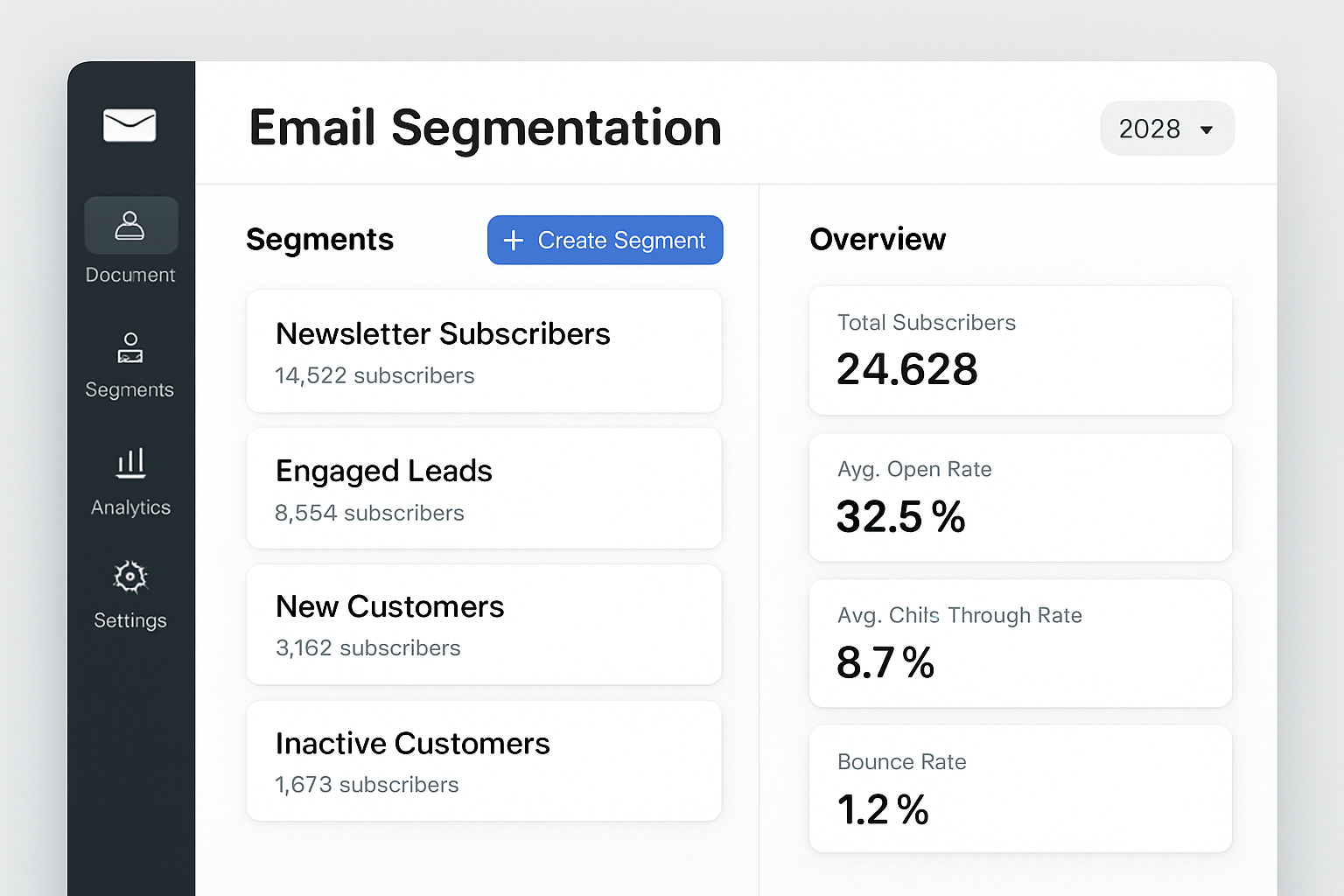
Segmentation by tags: the ideal method for flexible targeting
Segmentation by tags remains the most accessible and adaptable method for organizing your list. This system consists of assigning labels to contacts based on their interests, sources of origin, or past actions. These tags make it easy to organize contacts into groups that intersect or combine easily.
- Flexibility: You can create a large number of tags without overly complicating your list.
- Immediate visibility: The tag is a visible indicator that helps any team member understand a contact’s profile.
- Fast implementation: Tagging can be automated based on actions (click, purchase, etc.) with simple, previously defined rules.
For example, a contact may carry the following tags: topic-marketing, source-facebook, stage-new. This information makes it possible to personalize the content and optimize campaign performance through specific email segmentation.
| Type of tag | Objective | Example |
|---|---|---|
| Interest | Identify thematic preferences | topic-SEO, topic-ecommerce |
| Source | Know the origin of the contact | source-ads, source-newsletter |
| Behavior | Spot a specific action | click-pricing, purchase-1st-product |
| Cycle stage | Segment according to customer maturity | stage-new, stage-loyal |
In 2025, the strength of this method also rests on its integration into intelligent email automation systems, which automatically trigger sends tailored to the assigned tags. It’s the cornerstone of an effective, agile, and results-oriented email marketing strategy.
Segmentation by personas: refining your targeting according to typical profiles
Personas are among the most powerful tools for personalizing your campaigns. In 2025, we no longer talk about fictionalized portraits, but about synthetic, practical profiles that guide the content sent.
- Simple definition: A persona groups together key characteristics: level of maturity, needs, typical behaviors.
- Implementation: It is often created right at sign-up through a targeted question and can be modified via a preference center.
- Adapted journey: The content matches the experience level: beginners receive guides and checklists, intermediates case studies, and advanced users detailed comparisons and demonstrations.
| Persona | Characteristics | Adapted content |
|---|---|---|
| Busy beginner | Little time, needs quick results | Checklists, express tips |
| Methodical intermediate | Wants to go deeper | Case studies, advanced tutorials |
| B2B decision-maker | Pragmatism, expected ROI | Comparisons, figures, demos |
| E-commerce user | Specific purchasing preferences | Personalized offers, product guides |
By deploying this segmentation, you improve relevance and engage better. The persona is a qualitative filter that enriches audience targeting and elevates email personalization.
In 2025, the key is flexibility: the persona is not fixed. It evolves according to behaviors and feedback, thereby multiplying relational opportunities.
Using triggers & events to energize your email campaigns
Segmentation by triggers relies on precise events that set off a marketing action. These triggers make it possible to interact with contacts in real time, thereby strengthening email automation and effectiveness.
- Common types of triggers: click on a “pricing” link, content download, add to cart, prolonged inactivity.
- Clear, immediate response: each trigger must generate a specific action, such as a help email, a gentle reminder, or a reactivation campaign.
- Initial simplicity: start with 3-4 triggers you master well, before integrating more based on results.
| Trigger | Trigger event | Recommended response |
|---|---|---|
| Click on pricing page | Contact interested in the price | Send an email with FAQ and an invitation to a demo |
| Cart abandonment | Product added but purchase not completed | Personalized follow-up with an engaging offer |
| 30 days of inactivity | Contact with no recent interaction | Gentle, informative reactivation campaign |
| Lead magnet download | Request for specific content | Sending suitable complementary content |
These techniques contribute to a living, evolving email segmentation, pinpointing priority actions and promoting highly personalized campaigns.
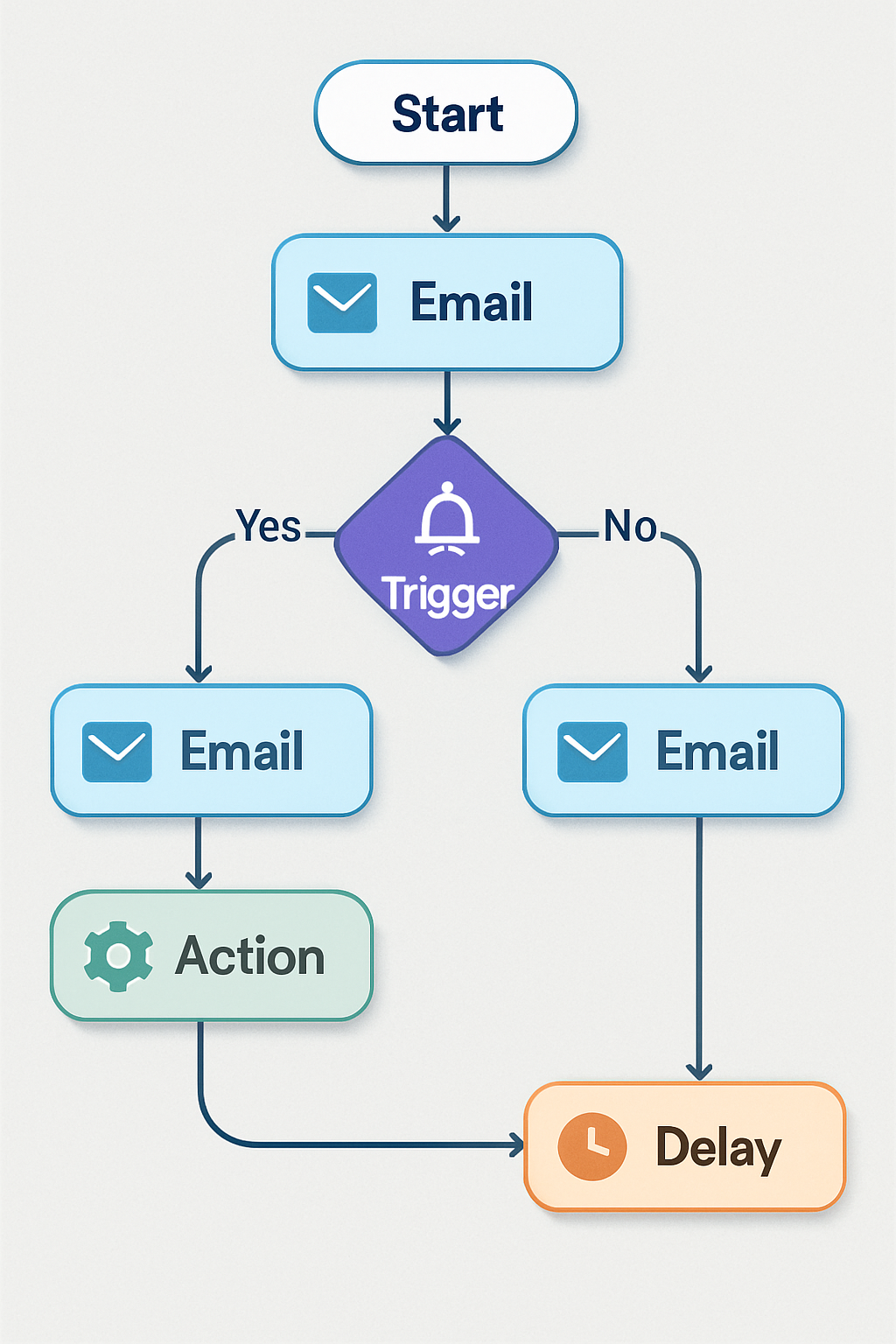
Ready-to-use scenarios to boost your campaigns according to your industry
In 2025, the rapid setup of automated scenarios makes it possible to optimize both time and effectiveness. Here are proven models, adaptable to your field:
B2C e-commerce
- Abandoned cart: D0 helpful reminder, D+1 social proof, D+3 gentle offer.
- Post-purchase: D0 thank-you, D+3 usage tips, D+10 review request + logical cross-sell.
SaaS
- Activation: D0 “create my first project”, D+2 “invite a colleague”, D+4 “discover 2 key features”.
- Pricing page visit: A short, targeted email with an invitation to a demo and FAQ.
Coaching / Training
- 7-day welcome: D0 resource, D+2 exercise, D+4 concrete case, D+6 entry offer.
- Reactivation of inactive contacts after 30 days: Case study, then a questionnaire to adjust the proposal.
| Industry | Scenario | Timing | Objective |
|---|---|---|---|
| B2C e-commerce | Abandoned cart | D0, D+1, D+3 | Purchase recovery |
| B2C e-commerce | Post-purchase | D0, D+3, D+10 | Loyalty and upsell |
| SaaS | Activation | D0, D+2, D+4 | User engagement |
| SaaS | Pricing visit | D0 | Conversion |
| Coaching / Training | 7-day welcome | D0, D+2, D+4, D+6 | Engagement and transformation |
| Coaching / Training | Reactivation of inactive contacts | D+30+ | Reactivation |
Measuring value and managing engagement with RFM and scoring
In 2025, effective segmentation doesn’t stop at static criteria. Customer value and engagement are at the center of the strategy thanks to RFM (Recency, Frequency, Monetary) methods and behavioral scoring.
- RFM: This method ranks customers according to their last interaction, purchase frequency, and amount spent. It makes it possible to distinguish VIPs from dormant customers.
- Engagement scoring: The sum of points based on email interactions, website visits, clicks on offers, and recent purchases.
- Life cycle: Tracking the New, Qualified, Customer, and Loyal stages, allowing for actions suited to the right moment.
| Criterion | Description | Practical use |
|---|---|---|
| Recency | Time elapsed since the last interaction | Targeted follow-up of inactive customers |
| Frequency | Number of purchases or interactions over a period | Define regular customers for special offers |
| Monetary | Total value spent | VIP treatment for exclusive events |
| Engagement score | Sum of interactions (opens, clicks, visits) | Prioritization of hot leads for the sales team |
| Life cycle stage | Position in the customer journey | Message suited to the stage (e.g., onboarding, loyalty) |
This finesse in classification considerably improves the performance of email marketing actions, because it directs messages toward segments with a high probability of conversion or reactivation.
Ensuring clean data and GDPR-compliant consent
No matter how sophisticated the segmentation, data quality and legal compliance remain non-negotiable. In 2025, these points are scrutinized even more closely:
- Explicit consent: Clearly indicate the frequency and use of emails. Always offer a visible, one-click unsubscribe option.
- Regular cleanup: Remove invalid addresses and quarantine inactive contacts to maximize deliverability.
- Simplified forms: Request only the data strictly necessary for relevant segmentation and good audience targeting.
| Action | Objective | Benefit |
|---|---|---|
| Clear consent | Comply with the law and build trust | Fewer complaints and better reputation |
| Database cleanup | Improve deliverability | Increase in open rate and clicks |
| Short form | Make sign-up easier | More qualified subscribers |
Respecting these rules protects both the brand and marketing results, while ensuring an optimal user experience. By combining consent and clean data, email segmentation takes on its full meaning and becomes a powerful lever.
Monitoring your KPIs and steering segmentation to optimize your email campaigns
Email segmentation is a dynamic process that requires regular monitoring of key indicators. 2025 demands acute vigilance on a few essential KPIs:
- Click-through rate per segment: Measure the specific responsiveness of each group.
- Post-click conversion: Assess the quality of prospects and their progression in the purchase journey.
- Unsubscribe rate: Monitor fatigue and content adaptation.
| KPI | Role | Related decision |
|---|---|---|
| Click-through rate | Measure active engagement | Adapt content and CTA |
| Post-click conversion | Assess the relevance of the offer | Optimize offers or landing pages |
| Unsubscribe rate | Detect dissatisfaction | Review the frequency and quality of sends |
It’s the dynamics of these figures over time that guide adjustments. Creating a mini dashboard configured according to segmented objectives facilitates fast, measured decision-making.
A/B testing and continuous optimization: the key to improving email campaigns
Perfecting your campaigns inevitably involves rigorous A/B testing. Applying this methodology allows you to isolate the effect of each variable on the open rate or click behavior.
- Variables to test: subject line, CTA text, link position, order of content blocks.
- Timing: allow enough time (7 to 14 days) to obtain statistically reliable results.
- Documentation: keep a precise log with hypothesis, results, and conclusions to build on the memory of your tests.
| Aspect tested | Objective | Expected impact |
|---|---|---|
| Subject line | Increase the open rate | More engaged readers |
| CTA | Improve the click-through rate | More action on the offer |
| Link position | Reduce friction | Better conversion |
| Order of blocks | Optimize reading | Enhanced clarity and impact |
Starting with quick wins like clarifying the CTA or the position of links is an excellent entry point. Big ideas will always be necessary, but successive small victories make the difference.
FAQ: answers to frequently asked questions about email segmentation
| Question | Answer |
|---|---|
| Where do I start if I have no existing segments? | Create at least three interest tags, a “new subscribers” segment, and a “pricing click” trigger. Then launch a scenario per segment. That already creates a significant impact. |
| How many personas should I configure initially? | Two or three personas are enough: beginners, intermediates, decision-makers. Then adjust based on real data to avoid over-engineering. |
| Do I have to redo all my forms to segment? | No, simply add a relevant field if necessary and favor post-click tags to evolve without breaking what already works. |
| How do I know if a segment is useful? | A segment is useful if it influences a clear decision: specific content, dedicated offer, or targeted follow-up. Otherwise, it’s better to merge it or delete it. |
| Does segmentation harm deliverability? | On the contrary, it improves it by reducing unwanted generic sends. Inboxes favor relevant messages and increase the open rate. |
