Email marketing remains an essential pillar of digital marketing, but its mechanisms, its objectives and its execution vary greatly depending on whether it is aimed at a professional audience (B2B) or an end consumer (B2C). This distinction lies not only in the nature of the targets, but also in the communication dynamics, the content and the engagement strategies. In 2025, as technological innovation continues to disrupt the ways we interact, it is crucial to understand the concrete differences between B2B and B2C email campaigns in order to maximize impact and conversion.
In the B2B context, often long sales cycles require patient nurturing, combined with in-depth personalization tailored to multiple decision-makers with precise professional expectations. By contrast, B2C aims more directly for immediate action with emails featuring emotional and visual content, targeting the individual’s personal purchasing motivation. These particularities translate into notable differences in segmentation, sending frequency, expected open rates and the conversion metrics used.
Companies running campaigns must therefore navigate between these worlds to choose their messages wisely, optimize their segmentation and orchestrate their customer journeys. Discover how the fundamental distinctions between B2B and B2C email marketing take shape in practices and results, and how to make the most of each approach through tailored content, automation and measurement strategies.
Sales cycles and their impact on email marketing campaigns in B2B and B2C
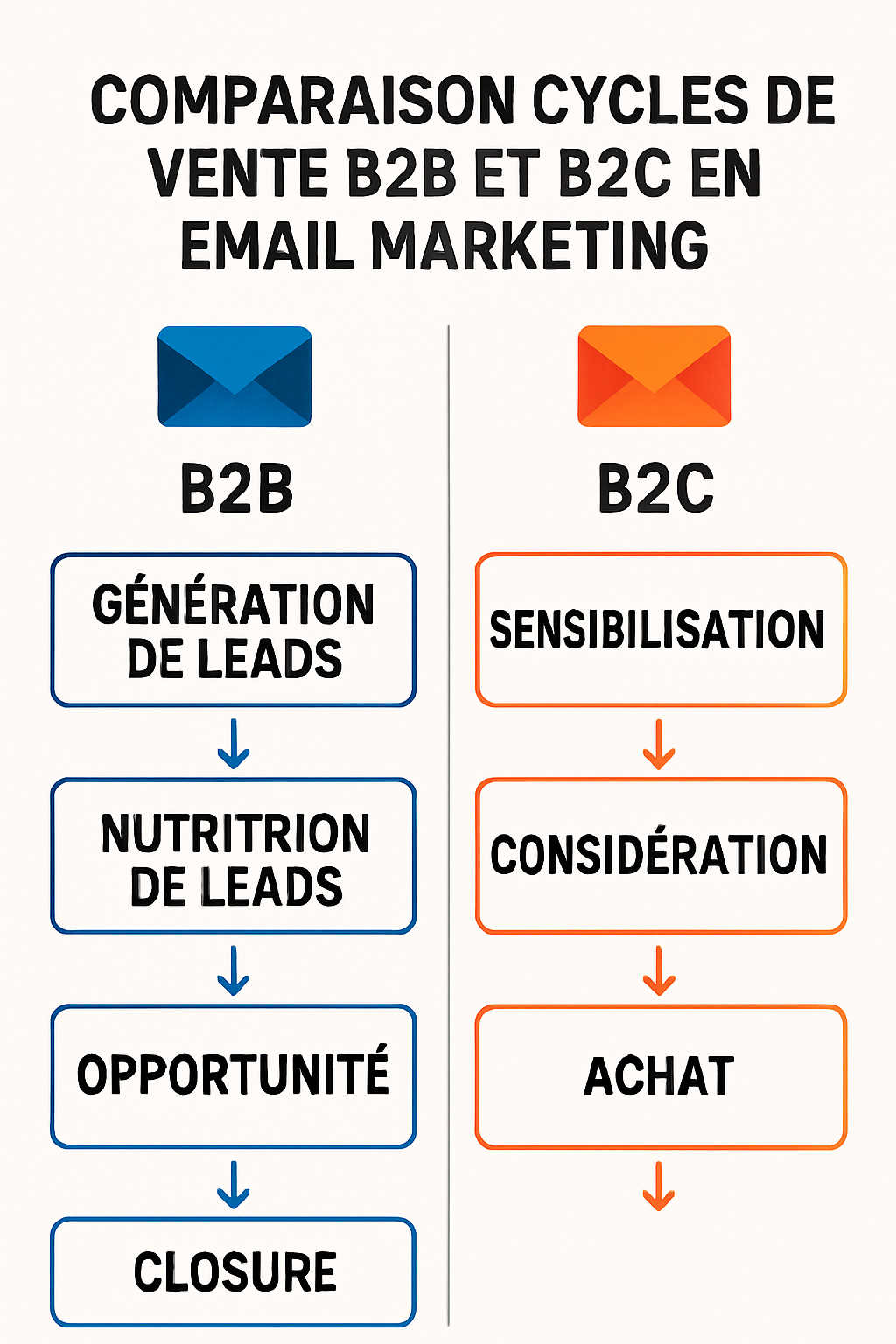
The sales cycle is the backbone of any email marketing campaign, dictating its duration, its objectives and its content. In B2B, this cycle is often characterized by an extended duration, stretching over several weeks or even several months. This length is notably explained by the complexity of decisions involving a buying committee, the need to validate the return on investment, and the in-depth analysis of solutions.
B2B campaigns must therefore be conceived as gradual guidance, with emails carefully designed to nurture the relationship, strengthen the brand’s credibility and guide the prospect at each stage of their journey. For example, sending white papers, case studies or customer testimonials at regular intervals makes it possible to educate decision-makers about the real benefits, while maintaining constant contact.
By contrast, the B2C sales cycle is generally shorter, often immediate or short-term. The purchasing decision usually rests on a single individual, sometimes influenced by their social environment but without any real demand for formal validation. Email campaigns in this context are primarily intended to spark a rapid purchasing impulse through limited-time promotions, product launches or exclusive offers.
The nature of the sales cycle deeply influences the frequency of email sends. In B2B, spread-out sequences with rich and varied content that establish a gradual dialogue are preferred. In B2C, closely spaced sends foster urgency and maximize the immediate engagement rate, particularly for promotional actions.
- B2B: long cycle, gradual nurturing, educational content
- B2C: short cycle, impulse-driven content, frequent promotional offers
| Characteristic | B2B | B2C |
|---|---|---|
| Cycle duration | Weeks to months | Minutes to days |
| Decision-makers | Committee, multiple stakeholders | Individual or family |
| Type of content | Educational, technical, informative | Emotional, visual, appealing |
| Sending frequency | Moderate, sequential | High, regular |
Personalization and segmentation: keys to success in B2B vs B2C email marketing
Personalization and segmentation have become decisive levers for increasing the relevance and performance of email campaigns in digital marketing. However, these concepts must be adapted to the very nature of the target audience and its specific expectations, depending on whether it is B2B or B2C.
In the B2B context, in-depth knowledge of industry sectors, the roles held by recipients, as well as their business challenges, makes it possible to build ultra-relevant messages. For example, a maker of software solutions could segment its contacts by role (IT director, buyer, sales manager) to offer tailored content: technical case studies for IT decision-makers, ROI benefits for purchasing.
Personalization does not stop at using the first name; it encompasses the integration of behavioral and contextual data, such as previous interactions, the stage in the sales funnel, or responses to earlier campaigns. This granularity enables efficient nurturing and better conversion.
For B2C, segmentation makes heavy use of demographic data, purchase history, stated preferences, and even browsing behavior. The goal is to offer highly targeted product recommendations and to anticipate consumers’ desires. For example, a ready-to-wear brand could segment by age, gender and seasonal habits to send personalized offers.
- B2B: segmentation by sector, role, purchasing cycle
- B2C: demographic, behavioral, geographic segmentation
| Segmentation criteria | B2B | B2C |
|---|---|---|
| Main basis | Industry, role, company size | Age, gender, location |
| Behavioral data | Actions in the sales funnel, previous email interactions | Past purchases, site browsing, clicks |
| Advanced personalization | Content tailored to specific business challenges | Custom product recommendations |
Concrete example: A B2B SaaS company sends a series of emails tailored to whether the contact is a CFO or a technical manager, while a B2C online sports store offers different deals depending on whether the customer tends to buy running or fitness equipment.
Content and formats: marketing adaptation between B2B and B2C emails
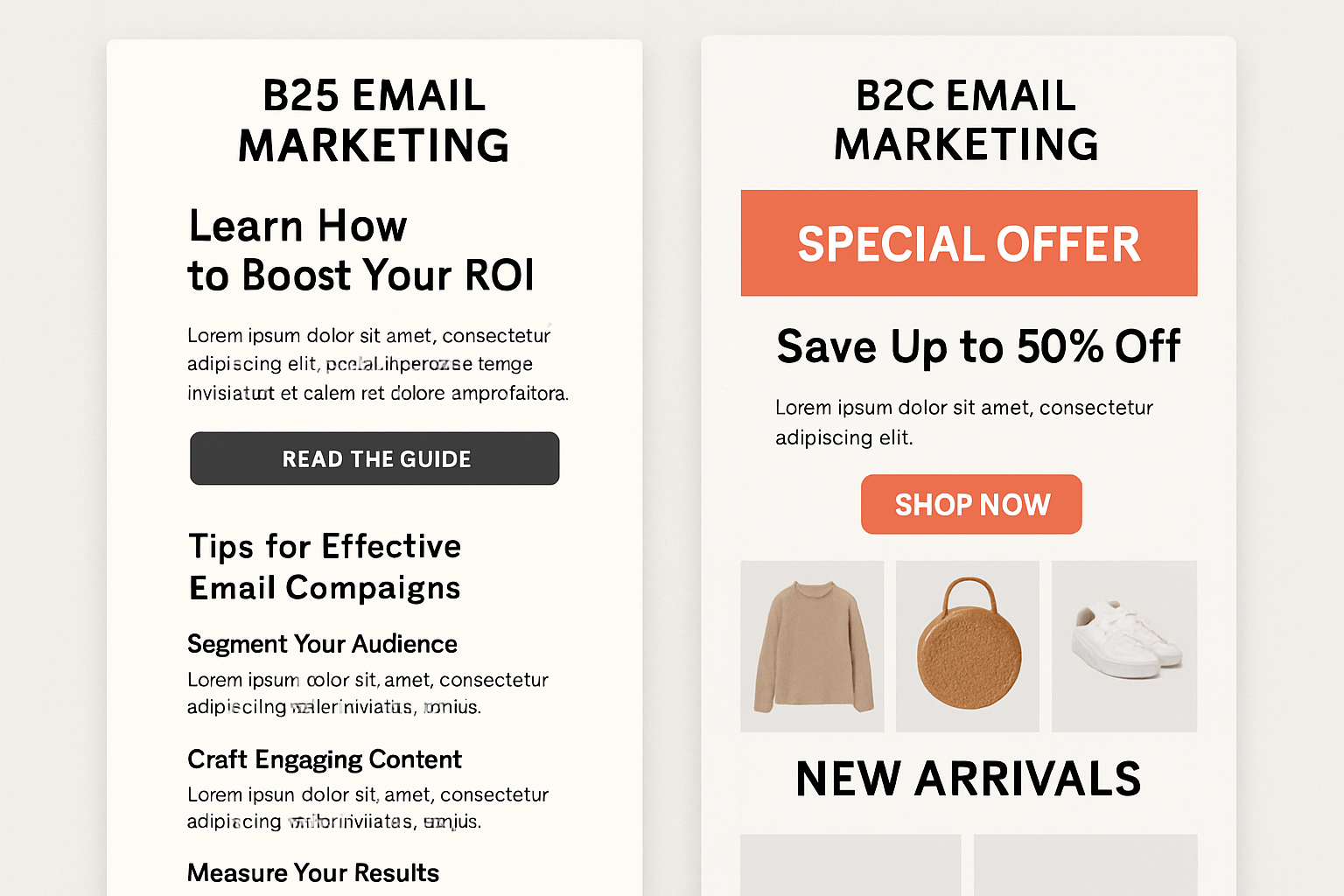
The type of content distributed in an email marketing campaign differs depending on whether you are addressing a B2B professional or a B2C consumer. This choice requires a careful analysis of the needs and expectations specific to each audience, as well as the commercial objectives being pursued.
Content to prioritize for B2B
In B2B, the content must provide immediate added value in the form of relevant and enlightening information, capable of convincing demanding decision-makers. The most effective formats are the following:
- White papers and case studies: in-depth documents illustrating the concrete resolution of a business problem.
- Webinars and tutorials: live sessions or videos to demonstrate expertise or a product.
- Customer testimonials: authentic messages reinforcing the credibility of the offering.
- Specialized blog articles: educational content detailing industry trends.
This content fosters a gradual building of trust and guides the prospect throughout the purchasing cycle, with a professional and clear tone, avoiding excessive promotion.
Content formats suited to B2C
In B2C, creativity and visual impact prevail in order to capture attention in often saturated inboxes. High-performing formats rely on:
- Attractive visuals: high-quality product photos, infographics.
- Promotional offers: discount codes, flash sales, gifts.
- Interactive emails: surveys, animations, product sliders.
- Personalized reminders: notifications for abandoned carts or customer birthdays.
The tone here is often familiar, oriented toward emotion and the customer experience, with the aim of triggering an impulse or recurring purchase.
| Aspect | B2B Marketing | B2C Marketing |
|---|---|---|
| Content objectives | Education, credibility, long-term relationship | Fast engagement, conversion, enjoyment |
| Preferred formats | White papers, webinars, case studies | Visuals, promotional offers, interactions |
| Tone | Professional, explanatory | Familiar, emotional |
| Examples | Industry newsletter, automated emails | Promotional campaigns, colorful newsletters |
Sending frequency and timing: optimizing email campaigns for a B2B or B2C target
The right sending rhythm is a key factor for maximizing the open rate and avoiding unsubscribes. B2B and B2C do not have the same sensitivities when it comes to the frequency and timing of emails.
In a B2B context, the frequency must be measured and respectful of the professional’s time. The goal is to be present without cluttering the inbox, typically at a weekly or biweekly cadence, depending on the length of the sales cycle. Choosing sending times, often early in the morning or mid-morning on weekdays, improves visibility.
On the contrary, a B2C audience can be more receptive to more frequent sends, particularly during promotional phases, sometimes with several emails per week. Weekends, evenings or even lunch hours are often conducive to reading and impulse buying. However, excessive emailing can quickly generate a high unsubscribe rate.
- B2B frequency: 1 to 2 emails per week, timing during office hours
- B2C frequency: 2 to 5 emails per week, flexible timing (evening, weekend)
| Criterion | B2B | B2C |
|---|---|---|
| Average frequency | 1-2 times/week | 2-5 times/week |
| Optimal send time | 8am-11am on business days | 12pm-2pm and 6pm-9pm, various days |
| Risk of excess | Slow fatigue, loss of interest | Drop-offs, rapid unsubscribing |
Automation and integration of email campaigns in B2B and B2C
The use of automation tools has become standard for the efficient management of email marketing campaigns, but their deployment requires a differentiated approach depending on the target audience.
In B2B, automations are part of sophisticated nurturing, with complex workflows that adapt to the prospect’s interactions. For example, a lead who downloads a white paper can automatically enter an email journey designed to deepen their discovery, with a parallel alert sent to a salesperson. CRM data plays a crucial role here in enriching segmentation and avoiding any redundancy.
In B2C, automation often aims to trigger immediate and highly personalized actions. Abandoned cart reminders, birthday emails, or scenarios based on purchasing or browsing behavior are at the heart of these strategies. These campaigns rely on fine-grained segmentation and the use of real-time triggers, often coupled with special offers to maximize conversion.
- B2B automation: long workflows, nurturing, integrated CRM
- B2C automation: immediate triggers, personalized reminders, offers
| Dimension | B2B | B2C |
|---|---|---|
| Timing objective | Long-term nurturing | Fast responses and follow-ups |
| Types of automation | Customer journey by stages | Cart reminders, birthdays, promotions |
| Integration | CRM, LinkedIn Sales Navigator | Social platforms, e-commerce |
Measuring performance: key indicators and optimization by campaign type
Measuring the effectiveness of an email marketing campaign makes it possible to continually adjust efforts and maximize the return on investment. Although there are universal indicators, certain KPIs stand out in a B2B or B2C context.
In the B2B space, attention focuses particularly on the open rate, the click-through rate and the long-term conversion rate (booking an appointment, a demo). Direct ROI can be difficult to observe immediately, with value often materializing over a horizon of several months.
In B2C, metrics more directly tied to sales are key: the open rate, the click-through rate to a product page, but also the revenue generated per email, the unsubscribe rate, or the customer retention rate. Immediate conversion is therefore essential.
- B2B: open rate, progression through the funnel, generation of qualified leads
- B2C: revenue per email, click rate, loyalty and unsubscribing
| KPI | Importance in B2B | Importance in B2C |
|---|---|---|
| Open rate | High, closely monitored | High, indispensable |
| Click rate | Important for engagement | Very important, directly linked to sales |
| Conversion rate | Focus on qualified conversion (appointment, demo) | Fast conversion to purchase |
| ROI | Difficult to measure immediately | Often quickly measurable |
| Unsubscribe rate | Moderate, an indicator of list quality | Important, impacts loyalty |
Complementary channels in digital marketing: how email fits between B2B and B2C
In an integrated strategy, email marketing often works in synergy with other digital channels. The choice of these channels varies depending on the B2B or B2C target and the type of messages to convey.
For B2B, LinkedIn dominates when it comes to lead generation and building credibility. Combining CRM, email marketing and professional networks enables targeted, relevant and tracked communication. SEO focused on business and technology terms complements these actions to capture prospects in the research phase.
Conversely, B2C relies on emotional and visual social networks such as Instagram, TikTok or Facebook. Integrating promotional offers by email with follow-ups via these platforms multiplies reach and conversion. Local SEO is also popular for capturing a nearby clientele.
- B2B: LinkedIn, CRM, industry SEO, expert newsletters
- B2C: Instagram, Facebook, Google Ads, local SEO, influencers
| Digital channels | B2B | B2C |
|---|---|---|
| Key social networks | Mainly LinkedIn | Instagram, TikTok, Facebook |
| Search | SEO on business keywords | Local and general SEO |
| Online advertising | LinkedIn Ads, targeted Google Ads | Google Ads, Shopping, Facebook Ads |
Adopting a differentiated email marketing strategy based on your target in 2025
In an ever more competitive digital market, differentiating your email approach based on the type of target is a critical success factor. In 2025, trends confirm the importance of precise segmentation, advanced personalization and coherent integration of campaigns within a broader marketing set of tools.
Here is a list of key tips for choosing your strategies depending on whether you are addressing a B2B or B2C audience:
- Rigorous analysis of your audience, its needs, behaviors and preferences.
- Tailored content: educational and rational in B2B, emotional and attractive in B2C.
- Targeted automation: long nurturing in B2B, fast triggers in B2C.
- Multi-channel integration: CRM and LinkedIn for B2B, social networks and local SEO for B2C.
- Continuous optimization through the analysis of the KPIs specific to each market.
The example of a fictional company specializing in professional software illustrates this approach. For its B2B audience, it organizes quarterly webinars and sends a sequence of in-depth emails tailored to each sector. In parallel, for its consumer-facing B2C offering, it multiplies weekly promotional campaigns, supported by attractive visuals and personalized reminders.
FAQ on the concrete differences between B2B and B2C email marketing
- Can you use the same channels in B2B and B2C?
Some channels such as email, SEO and Google Ads are common, but the way they are used differs profoundly, both in tone and in segmentation and content. - Can B2B benefit from social networks?
Yes, but the key network remains LinkedIn. Facebook and Instagram are less effective for B2B lead generation, but useful for brand awareness. - What difference in budget do we see between B2B and B2C?
B2B invests mainly in content creation and long-term SEO, while B2C favors paid advertising with more immediate results. - How do you optimize the open rate depending on the type of email?
In B2B, professional contextualization and relevant content are essential. In B2C, the visual hook and the quick call to action play a key role. - Should you automate your emailing campaigns?
Yes, automation is a powerful lever, provided you adapt the workflows to the B2B sales cycle or to the fast behaviors of B2C.
