Launching a SaaS (Software as a Service) product does not end with acquiring a new user: that is precisely the moment when a crucial strategic journey begins. The email onboarding sequence is at the heart of this essential stage. In 2025, as the market for SaaS solutions is developing at breakneck speed, the challenge is to capture users’ attention from the moment they sign up and to guide them effectively toward fully activating the product’s features. Every email is a valuable opportunity to deliver a personalized experience, boost user engagement and increase customer conversion. Marketing automation plays a decisive role here in deploying targeted welcome campaigns tailored to individual behavior. Yet designing an optimal sequence requires rigor, creativity and a keen understanding of the business and technical expectations of a demanding professional audience.
Many experts agree that a well-designed email onboarding significantly accelerates the reduction of SaaS churn and generates a strong ripple effect toward customer loyalty. By thoughtfully structuring these email sequences, companies can simultaneously teach, reassure and prompt action without creating friction or information overload. In this highly competitive market, every email must become a small strategic asset capable of turning a mere sign-up into an active user, convinced by the value delivered.
This report takes an in-depth look at the best practices observed in the email onboarding cycles of the market’s leading SaaS companies. We will explore the underlying mechanisms, the effective content formats, the high-performing automated dynamics and share concrete examples of sequences that turn early interactions into lasting success.
Why a well-built email onboarding sequence improves customer conversion in SaaS
Onboarding in the SaaS sector is not just about sending welcome emails. It is a complex process that aims to reduce the gap between a user’s sign-up and their active adoption of the solution. A properly architected email onboarding sequence has a direct influence on customer conversion; here are several reasons backed by field observations and recent data.
Encourage fast activation with targeted actions
The key to successful email onboarding is to steer users toward steps that are easily accessible and highly valuable. Rather than trying to explain the entire product, the sequence should invite users to take one or two concrete first steps. For example:
- Create a first project, board or campaign.
- Import key data from other tools.
- Discover a flagship feature through a short video tutorial.
This focus on simple actions maximizes the likelihood that the user will quickly experience a tangible benefit, thereby reducing early drop-off.
Reduce friction through progressive communication
Email onboarding delivered in several stages allows the discovery process to be spread out. Instead of overwhelming the user with a massive flood of information, each email focuses on a single key topic. This gradual approach builds engagement by lowering the cognitive load and the perceived complexity of the product. It is one of the major factors in earning trust.
Use marketing automation for contextual engagement
The dynamic personalization offered by marketing automation makes all the difference. A high-performing email onboarding sequence uses behavioral data: open rate, clicks on a link or actual use of a feature. Based on these signals, the algorithm adapts the delivery of the following messages, going so far as to re-engage users who appear stuck with targeted content or human support.
Connect the product experience to a smooth commercial journey
Email onboarding should be seen as a bridge between the free-trial phases and conversion to a paid plan. Every email is a multiplied opportunity to illustrate the return on investment, especially for freemium users. For example, presenting, in short sentences, business use cases, or better still, sharing quantified studies of productivity improvements.
Summary table of the benefits of a strategic email onboarding sequence
| Key Benefits | Direct Impacts in SaaS | Concrete Examples |
|---|---|---|
| Fast activation | Reduced initial churn, accelerated skill-building | Prompting the creation of a first project via simple tutorials |
| Reduced friction | Improved trust, fewer support tickets | Short emails with one focus per message & tooltips |
| Active personalization | Higher engagement, greater satisfaction | Targeted follow-ups based on uncompleted actions |
| Optimization of the sales cycle | Faster conversion to paid subscriptions | Emails showcasing customer cases and business benefits |
The effectiveness of an email onboarding sequence should never be underestimated: it acts as a decisive lever on the success and durability of SaaS companies in 2025.
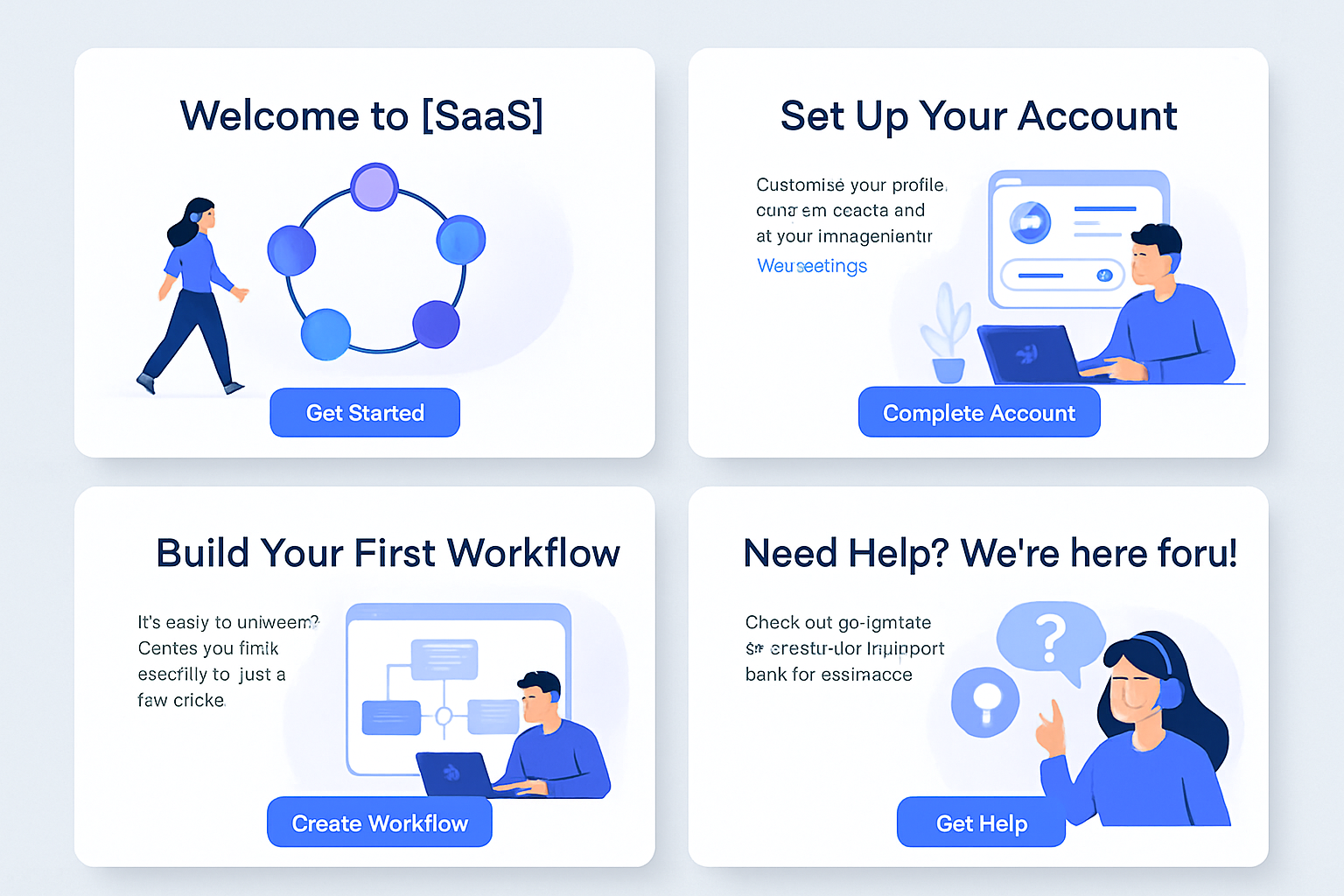
The 7 fundamental elements for designing impactful SaaS email onboarding sequences
Designing an email sequence for SaaS onboarding requires perfect mastery of the message, the tone and the engagement mechanisms. Here are the 7 essential pillars that guide the creation of high-performing welcome campaigns today.
- Clear and engaging email subject lines: each subject line must announce the content concisely and encourage clicks.
- A focus on simple, quick steps: the content encourages an action that is easy to complete, avoiding any unnecessary technical jargon.
- A brief message centered on a single goal: each email targets a precise intent, which makes it easier to remember and to engage with.
- Inclusion of visual elements: screenshots, GIFs or videos help make the product experience tangible.
- A single, obvious CTA (Call To Action): one clear button/action increases the conversion rate at each stage.
- Behavioral sequencing: the sequence adapts to the observed responses and interactions, ensuring the relevance of the messages.
- Inclusivity and personalization: greeting the user by name and integrating personalized content strengthen the emotional bond.
Each element aims to simplify the relationship between the brand and the user, maximize functional adoption and maintain positive momentum through to conversion.
| Element | Objective | Illustration | Expected impact |
|---|---|---|---|
| Clear email subject line | Encourage opening | “Welcome to [SaaS Name]! Your first step” | Increased open rate |
| Simple micro-actions | Support hands-on adoption | “Create your first campaign in 3 minutes” | Fast activation |
| A single CTA per email | Maximize the click rate | “Get started now” | Increased engagement rate |
| Instructional visuals | Ease understanding | Animated tutorials | Less user confusion |
| Personalization | Create an emotional bond | “Hello Jean, here is your journey” | Better engagement |
| Behavioral sequences | Adapt the messaging | Follow-ups based on behavior | Reactivation of stuck users |
Case study: Clay’s email onboarding sequence for progressive skill-building
Clay, a company specializing in automating sales prospecting through AI-powered workflows, designed an exemplary email onboarding sequence structured in six progressively immersive stages. This approach demonstrates the effectiveness of a well-managed journey that focuses on pragmatic learning and building confidence.
A detailed breakdown of Clay’s engagement journey
Each email delivers a targeted message accompanied by a simple action, illustrated with step-by-step visuals. Here are the highlights:
- First email: a warm welcome, a promise of time savings and an invitation to take the introductory training, Clay University 101.
- Second email: guidance on discovering how to identify your first prospects by creating a dynamic table – the central action.
- Third email: an advanced look at the automated data enrichment features, clearly explained with a step-by-step walkthrough.
- Fourth email: a spotlight on Claygent, the internal AI tool for in-depth research and transcript analysis.
- Fifth email: a step-by-step method for exporting enriched data to common CRMs.
- Sixth email: encouragement to make use of advanced resources, the blog, templates and additional training.
Why is this sequence particularly effective?
Clay has mastered the art of teaching in small pieces. Each message is deliberately succinct, visual and action-oriented. At every moment, the user understands what is expected, knowing exactly where they stand in their journey. The promise of progress across six steps creates positive anticipation. This approach also limits cognitive overload, which is crucial during SaaS onboarding.
| Main objective | Key content | Effect on the user | |
|---|---|---|---|
| 1 – Welcome | Present the value | Clarity on time savings + intro training | Initial motivation |
| 2 – Find leads | Take action | Guide to a first table & prospecting | Immediate activation |
| 3 – Enrichment | Deepen usage | Explanation of enrichment workflows | Confidence in the tool |
| 4 – Built-in AI | Demonstrate innovation | AI use cases & invitation to test | Interest in new features |
| 5 – Export | Ease integration | Detailed CRM export steps | Technical peace of mind |
| 6 – Go deeper | Build loyalty & expand usage | Advanced resources & blog | Long-term retention |
This sequence naturally adapts to any SaaS looking to turn onboarding into a genuine engine of customer conversion while offering a user experience that respects individual learning paces.
Personalizing your onboarding emails to boost user engagement and reduce churn
In 2025, personalization in email sequences is no longer a luxury but an absolute necessity. Users expect journeys tailored to their profile, their industry and their pace. Generic communication seriously harms the experience and customer conversion.
Segmenting users from sign-up
Defining relevant segments from the very first contact is strategic. What is commonly captured:
- The recipient’s role (management, operations, IT, marketing).
- The size and industry of the company.
- The primary use case sought in the solution.
This segmentation makes it possible to deploy personalized emails that are technically simple to automate yet highly effective in driving engagement.
Content and calls-to-action tailored to the profile
A marketing director will receive an email that highlights lead generation and CRM integrations. A technician will prefer configuration guides and technical webinars. Finely tuning the calls-to-action leads to more clicks and more activity.
Marketing automation and behavioral tracking
Integrating advanced marketing automation solutions makes it possible to detect users’ actions or inactions and to adjust the sequence. For example:
- Follow up by email with users who have not yet crossed a key threshold.»
- Send a personalized invitation to a webinar to those who started a tutorial but did not finish it.
- Offer a call with an expert after a period of inactivity.
This approach significantly reduces churn and improves customer loyalty.
| Type of personalization | Advantages | Practical examples |
|---|---|---|
| Contextual personalization | Better relevance, a sense of attentiveness | Use of the first name + specific recommendations |
| Role-based segmentation | Tailored and relevant messages | Distinct emails by profile (Marketing vs IT) |
| Behavioral follow-ups | Recovery of lost users | Emails targeting uncompleted steps |
| Personalized offers | Conversion optimization | Promotion of plans tailored to the profile |
This personalization must be seamless and always respectful of privacy. An email sequence that speaks to “the user” reaps far more than clicks; it earns their trust and their lasting engagement.
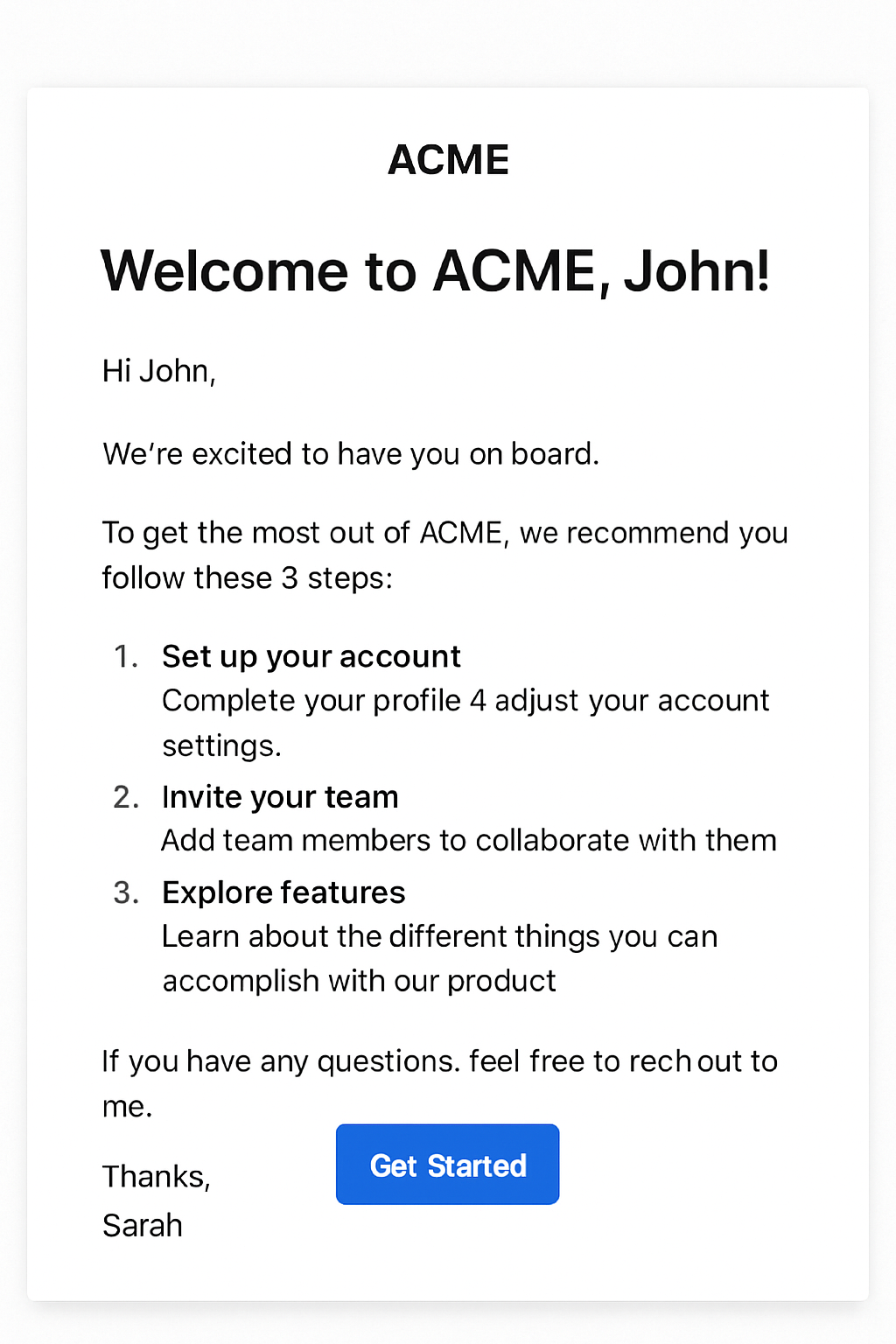
Integrating video content into email sequences for more effective SaaS onboarding
Video is now establishing itself as an essential channel within email onboarding sequences for SaaS companies. Its instructional potential, combined with its engagement effectiveness, makes it a powerful lever.
Why integrate video into a welcome campaign?
Video earns its place in onboarding for a practical reason rather than a statistical one: it explains a long or technical process in two minutes, where the written equivalent runs to several screens. Treat published figures on video lift with caution, since most of them come from companies selling video tools and almost none disclose the sample.
Types of videos that work well in onboarding
- Quick product overviews with concise narration.
- Step-by-step demonstration tutorials.
- Interactive webinars with replay availability.
- Customer testimonials (“success stories”) illustrating concrete benefits.
Best practices for embedding a video in your emails
- Use an attractive thumbnail with a clear play button.
- Prefer a short message accompanied by a direct link to the hosted video (YouTube, Vimeo).
- Include an obvious call-to-action after viewing (for example: “Discover our complete guide”).
- Ensure mobile compatibility and fast loading times.
| Integration method | Advantages | Limitations |
|---|---|---|
| Direct embedding as an animated GIF | Captures attention quickly | Limited quality, email weight |
| Clickable thumbnail leading to the video | Smooth user experience | Requires an external click |
| Links to live webinars | Real-time interaction | Strict commitment to a set time |
Within email onboarding sequences, video helps reduce the drop-off rate and builds customer loyalty by making the benefits of the SaaS explicit and tangible.
How to automate email sequences for continuous optimization of SaaS onboarding
The central role of marketing automation in an onboarding strategy is now indisputable. It makes it possible to deliver the right message, at the right time, to the right user, thereby reducing manual effort and increasing impact.
Setting up an effective automation system
First, you need to identify the key stages of the user cycle that warrant sending an email. For example:
- Sign-up confirmed.
- First use recorded.
- Failure to complete a crucial step.
- Upcoming expiration of a trial period.
Each event triggers a personalized automatic response, which can itself evolve according to reading and action statistics.
Measuring performance and automatically adjusting your sequence
Automation feeds on the data generated. The goal is to track:
- Open and click rates.
- The functional activation rate of users.
- The conversion rate to a paid subscription.
- Drop-off points and any dissatisfaction.
Thanks to these indicators, email sequences are optimized in a continuous loop. For example, a message that underperforms on a given segment can be replaced or modified. A/B tests are carried out systematically.
A concrete example: behavioral follow-ups at ActiveCampaign
Facing trials that are often delayed in their setup, ActiveCampaign sends a series of gradual emails, alternating technical reminders, feature demonstrations and built-in social proof. The behavioral approach ensures personalization based on real activity, encouraging users to complete the steps.
| Automated feature | Expected effect | SaaS example |
|---|---|---|
| Sign-up-based triggering | Fast launch of the customer relationship | ActiveCampaign – first welcome email |
| Targeted behavioral emails | Churn reduction through active follow-up | ActiveCampaign – setup follow-up emails |
| Systematic A/B testing | Continuous optimization of messages | Clay – adjustment of the onboarding sequence |
| CRM and analytics integration | Centralization of data and reporting | Asana – tracking of user engagement |
The current sophistication of marketing platforms makes powerful automation accessible even to SMEs, enabling constantly renewed onboarding optimization.
Exemplary SaaS email onboarding sequences: winning strategies and what matters
Exploring the onboarding processes of major companies helps us understand what really works in a professional SaaS context. These strategies are often agile, embodied by innovative and pragmatic examples. Here is a concise overview of some notable successes.
Slack: interactive and playful learning
Slack relies on a human “bot” contact that enables immediate and intuitive interaction. The user is invited to learn by doing, with tooltips and “empty states” that suggest appropriate actions. Trained this way, the customer quickly adopts the product, which sustainably improves user engagement.
HubSpot: personalization by goals and segmentation
HubSpot breaks down the experience according to the customer’s role and specific objectives. A visible progress bar motivates users to complete the setup, and each piece of content is calibrated to be immediately relevant. Marketing automation also makes it possible to adapt the sequences based on the initial responses, strengthening customer conversion.
Mailchimp: step-by-step support and positive reinforcement
Mailchimp reframes the complexity of email marketing into clear steps while injecting a dose of humor and congratulations into the journey. This strategy reduces product-related stress, lowers the unsubscribe rate and establishes a positive atmosphere around usage.
| Company | Type of onboarding sequence | Main objective | Key result |
|---|---|---|---|
| Slack | Interactive learning | Engagement and fast adoption | Shorter learning curve |
| HubSpot | Personalization by goals | Relevant user experience | Increased conversion rate |
| Mailchimp | Breakdown into simple steps | Reduced user stress | Lower drop-off rate |
These models reflect the diversity of approaches, but they share a common foundation: thoughtful, adaptable and user-centered email onboarding.
How to measure success and continuously optimize your SaaS email onboarding campaigns
Setting up a sequence would be of little value without rigorous tracking and ongoing improvement. Data proves essential for refining marketing automation and maximizing customer conversion over the medium and long term.
Key indicators to monitor
- Open rate: an indicator of the relevance of your subject lines and send time.
- Click rate: measures interest in taking the desired action.
- Activation rate: the ratio of users who have completed the expected key steps.
- Unsubscribe rate: a signal of potential friction or email overload.
- Final conversion rate: the number of users moving to a paid plan.
Optimization techniques
Optimization relies on ongoing A/B tests of subject lines, content, CTAs and frequency. Using behavioral analysis tools makes it possible to pinpoint exactly where users get “stuck.” Fast adaptation ensures that the email sequence remains a strength rather than a weakness.
| Metric | Objective | Tool or method |
|---|---|---|
| Open rate | Maximize visibility | A/B testing of subject lines |
| Click rate | Stimulate micro-actions | CTA button optimization |
| Activation rate | Ensure user progression | Heatmaps and journey analysis |
| Conversion rate | Increase paying subscribers | Integrated CRM reporting |
Precise, iterative analysis is the key to turning an email onboarding campaign into an ROI-driven engine within the SaaS business model.
FAQ on SaaS email onboarding sequences: answering your essential questions
| Question | Answer |
|---|---|
| What should an effective first SaaS onboarding email contain? | It should clearly present the product’s added value, invite the user to take a simple first step and make sure they know what to expect in the following emails. |
| How do you choose the right sending frequency? | The frequency must be close enough to maintain attention, but not to the point of saturating. Typically, one email every 2-3 days, adaptable based on user behavior, is optimal. |
| Do you always have to include videos in your sequences? | No, but a well-placed video can improve engagement and quickly clarify complex concepts. It should remain complementary to the text, without replacing it. |
| How does marketing automation improve onboarding? | It makes it possible to deliver a personalized message at the right moment, adapt the sequence to the actual journey and automatically follow up on uncompleted steps, thereby increasing the conversion rate. |
| Can you force a user to follow a tutorial in the sequence? | It is better to leave a choice, a “skip the tutorial” button, to respect the user’s freedom and avoid frustration or drop-off. |
