In SaaS, email marketing has become as one of the essential pillars of growth and customer retention. This channel, which remains the most cost-effective in terms of return on investment, allows you to communicate with precision, speed, and personalization. Whether for onboarding, activation, retention, or upsell, every email interaction is a powerful lever capable of strengthening the user relationship and optimizing conversion. In 2025, this strategy incorporates technological innovations such as artificial intelligence and automated campaigns, while being calibrated according to the behaviors and life cycle of SaaS customers. In an environment where inboxes are becoming saturated, the challenge is to create impactful, segmented, high-value email campaigns that don’t just get seen but generate genuine engagement and a concrete impact on revenue.
Developing an effective email strategy for a SaaS is no longer just about sending generic newsletters or blasting out promotional offers. It’s about adopting a data-driven approach centered on the user journey, combining fine segmentation, advanced personalization, and intelligent automation. This approach involves understanding the mindset of each segment, adapting the content and tone according to the customer’s stage in their life cycle, and using modern tools to deploy complex scenarios in record time. We invite you to discover, step by step, all the key elements that allow you to raise a SaaS email marketing campaign to a professional level, in service of your acquisition, activation, and retention goals.
Understanding the specifics of the SaaS model for a high-performing email strategy
The SaaS sector has particularities that deeply influence the nature of email marketing campaigns. Unlike a classic transactional model, SaaS success relies on a subscription model, which requires adopting a continuous and progressive approach to managing the customer relationship. The central objective is to optimize Customer Lifetime Value (CLV) by maximizing retention and upsell, while limiting churn.
To build a relevant email strategy, it is imperative to segment users in a fine-grained way. This segmentation is not limited to classic demographic data but relies on behaviors and the customer life cycle. For example, we generally distinguish:
- Prospects or unconverted leads, who are discovering or testing the product;
- Users in a trial or free trial period, for whom activation must be optimized;
- Active customers, to be retained by building engagement;
- Churned or inactive customers, to be reactivated;
- Premium customers or those with high upsell potential.
Beyond segmentation, content development must be oriented toward customer benefits, supporting product adoption, and the proactive resolution of the problems they encounter. Message personalization plays a key role, ranging from the simple use of a first name to adapting the content to specific software uses or business needs.
In summary, here are the fundamental pillars for a well-suited SaaS email strategy:
- Fine behavioral segmentation incorporating the customer life cycle stage and product usage data;
- Personalized, value-oriented content to precisely address each stage of the journey;
- A suitable cadence to nurture the relationship without saturating the inbox;
- Intelligent automation scenarios that deliver the right message at the right time.
| User Segment | Email Objectives | Recommended email types |
|---|---|---|
| Prospects & Leads | Acquire and convert | Introduction emails, nurturing, webinar invitations |
| Trial users | Fast activation and adoption | Onboarding emails, tutorials, special offers |
| Active customers | Engagement and retention | Product newsletters, new feature notifications |
| Churned customers | Reactivation | Re-engagement emails, satisfaction surveys |
| Premium users | Upsell / Cross-sell | Exclusive offers, invitations to private events |
These fundamentals, clearly understood and applied, set the stage for designing email campaigns that are data-oriented but also deeply human, which is essential for building trust and encouraging long-term engagement.
Creating effective SaaS email marketing campaigns through automation
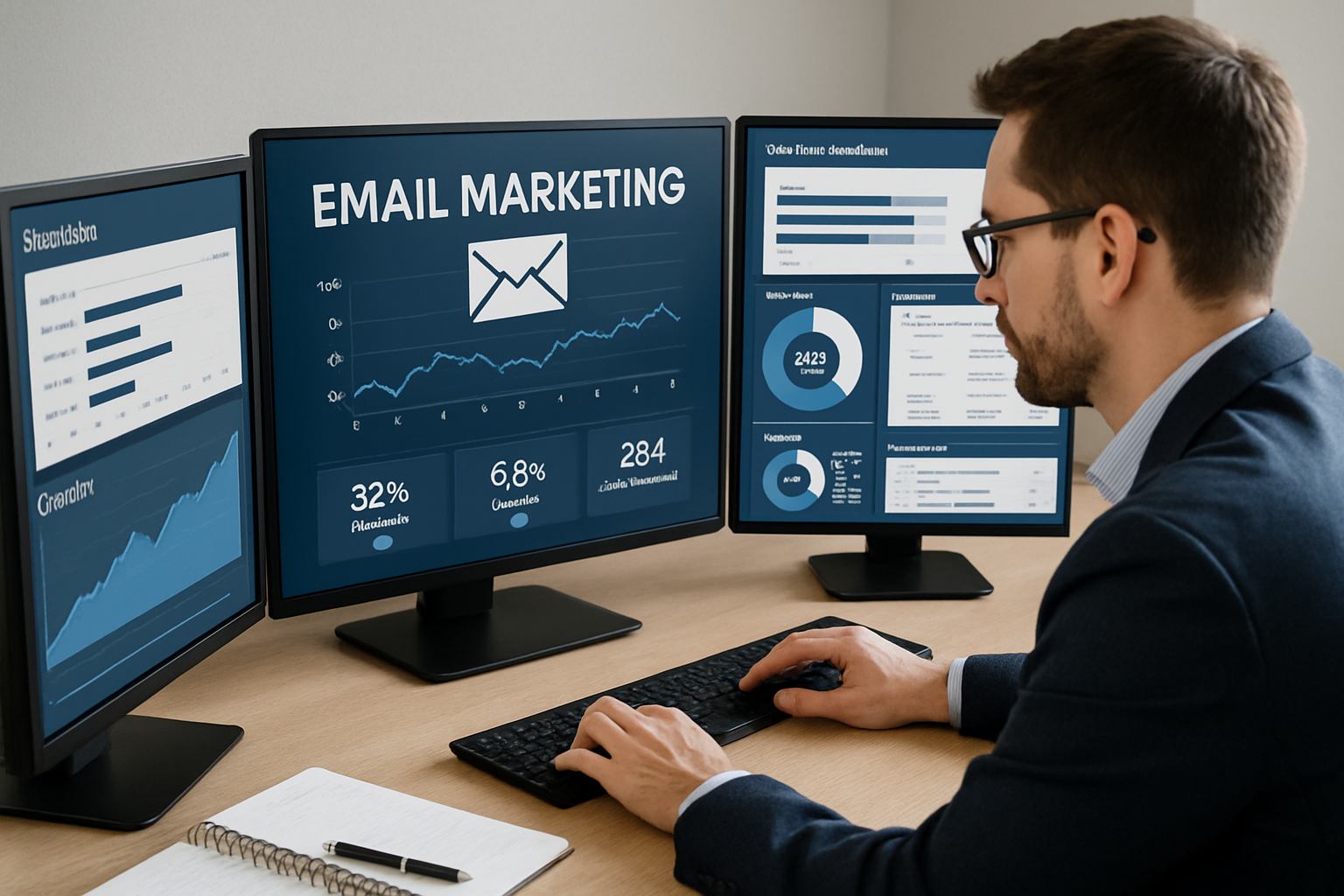
Automation is a decisive strategic lever in email marketing dedicated to SaaS. Faced with a user base that is often dense and heterogeneous, it is impossible to manually handle the individualized sending of tailored messages. A well-designed automated email strategy not only saves time but, above all, delivers a relevant message based on the actions or inactions of each user.
The most common automated scenarios revolve around triggers tied to user behavior. For example:
- Free trial sign-up: launching a welcome and onboarding sequence;
- Prolonged inactivity: sending a personalized reactivation email;
- Frequent use but no switch to a paid plan: offering webinars or demos to overcome hesitations;
- Use of a new feature: an in-depth discovery message or advanced use case;
- Subscription anniversary: a personalized message with an exclusive offer.
Table summarizing a few key scenarios and their objectives:
| Trigger | Objective | Email type | Frequency |
|---|---|---|---|
| New user sign-up | Activation and onboarding | Series of educational emails | Days 1, 3, 7 after sign-up |
| User inactivity | Reactivation | Personalized follow-up email | After 14 days without activity |
| Imminent churn | Fighting churn | Special offer or survey | 30 days before subscription ends |
| Heavy feature usage | Upsell/Cross-sell | Advanced proposal emails | Ongoing based on usage |
These automations, when well orchestrated, significantly improve open rates and maximize conversion by personalizing the message at the right time. Modern tools increasingly offer built-in algorithms to optimize timing and content, which further amplifies the reach and effectiveness of SaaS email campaigns.
Advanced segmentation and lead management: the heart of the SaaS email strategy
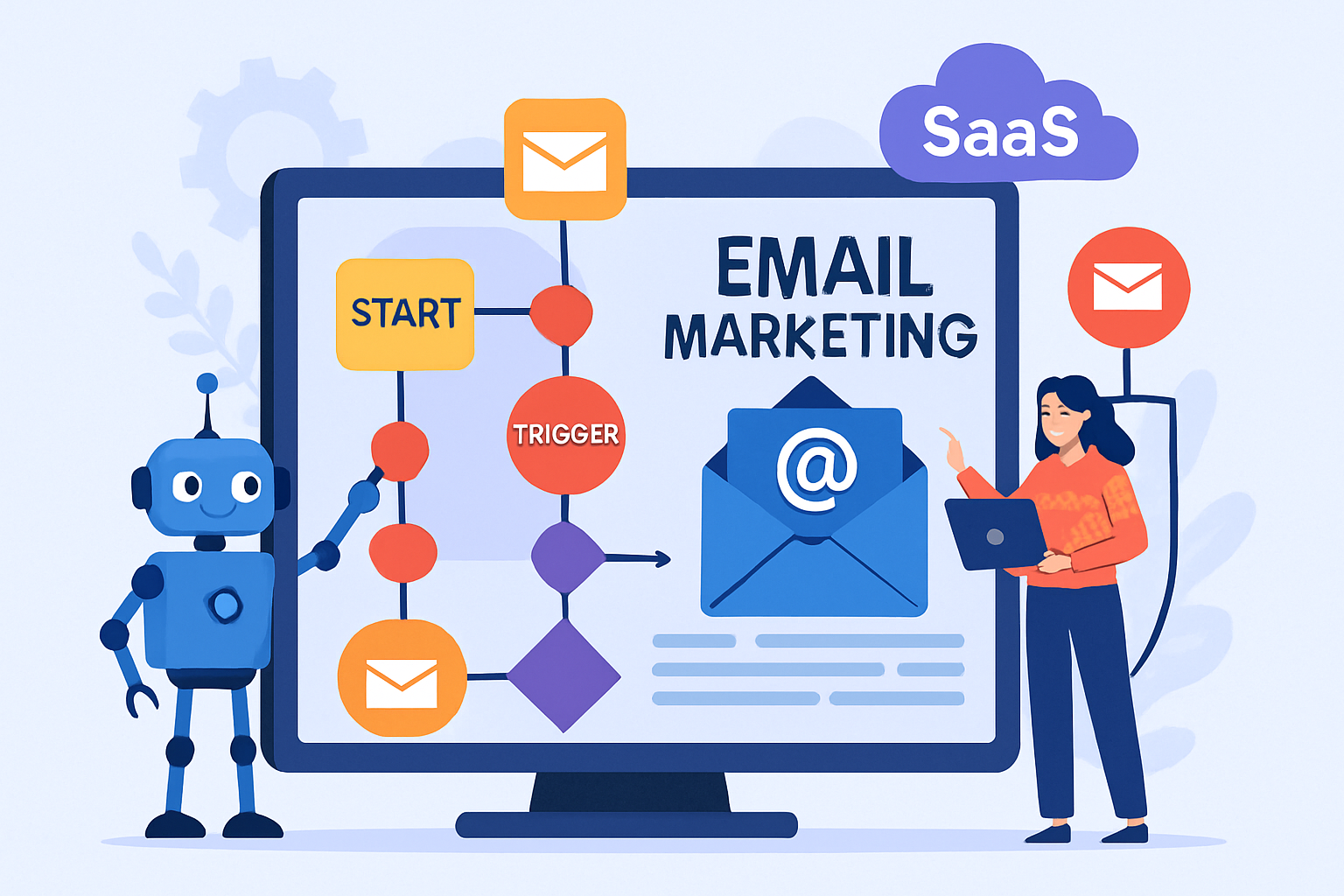
Segmentation pushes the SaaS email strategy beyond the basics, offering the ability to deploy content finely tailored to each user profile. Lead management in this context is no longer limited to simple categorization but to constant refinement based on behavioral and transactional interactions.
Examples of advanced segmentation criteria:
- Demographic data (company size, industry, location);
- Product engagement (frequency of use, features used);
- Responses to previous emails (clicks, opens, conversions);
- Life cycle stage (new, active, churned);
- Type of subscription or usage (free, premium, enterprise).
Segmentation is also a powerful lever for optimizing content personalization. A relevant message that addresses a specific need will have a greater impact on the engagement rate and conversion. Here are some best practices to incorporate:
- Avoid untargeted mass sends in favor of segmented campaigns;
- Incorporate dynamic variables into the content (name, company, product usage);
- Experiment with A/B tests for different content versions;
- Continuously analyze performance to adjust segmentation and targeting.
| Segmentation criterion | Advantages | Example of application |
|---|---|---|
| Usage behavior | Send hyper-personalized emails based on activity | Remind a low-activity user to try a key feature |
| Life cycle stage | Adapt messages according to the customer journey stage | Onboarding email for a recent user |
| Demographic data | Target by industry or company size | Special offer for SMEs in the Paris region |
This advanced segmentation improves user satisfaction by offering tailored content and generates more qualified leads. Agile management of user profiles, coupled with fine segmentation, is a major asset for effectively steering the email strategy.
The segmentation that matters most in SaaS
Splitting the list by recent activity and subscription type is the single most useful split in SaaS, because those two fields answer the only questions that change what the email should say: is this person using the product, and are they paying for it. A trial user who has not logged in since signup needs an onboarding nudge. A paying customer who uses the product daily needs anything but that. Sending both the same message wastes the send on one of them.
Building personalized, convincing content to boost conversions
In the field of SaaS email marketing, content creation is both a science and an art. To turn a campaign into a powerful conversion engine, the content must be meticulously crafted, centered on real benefits for the user, and paired with persuasive copywriting.
The guidelines for effective email content include:
- A catchy subject line, encouraging opening without falling into spam or clickbait;
- A quick introduction that captures attention by presenting the value in the very first lines;
- Clear, segmented content, with airy formatting that is easy to read on mobile;
- A strong call-to-action (CTA), visible, understandable, and engaging;
- Advanced personalization at the message and visual level, strengthening closeness with the recipient.
An illuminating example lies in Shopify’s welcome email, which combines simplicity, personalization by first name, and a clear proposal of next steps, generating excellent activation. The moderate use of animations in marketing emails, as at Litmus, draws attention without harming the clarity of the message. These practices improve engagement while enhancing the brand.
| Element | Impact on conversion | Example of implementation |
|---|---|---|
| Personalized subject line | Increases the open rate | Including the first name in the subject line and an element of surprise |
| Visible CTA | Encourages clicks and action | Colored button and clear incentive text |
| Segmented content | Improves the conversion rate | Emails tailored to current usage |
This content methodology must always be adjusted based on analytical feedback. Regular A/B tests on subject lines, visuals, or CTAs help push optimization and identify what resonates best with each user segment.
Measuring, analyzing, and optimizing the performance of SaaS email campaigns
Mastering the key metrics is one of the foundational skills for succeeding in SaaS email marketing. You can only effectively optimize what you measure precisely. Data allows you to understand how campaigns perform, where the levers for improvement lie, and how to act in a targeted way.
The main indicators to monitor are:
- Open rate: an indicator of the relevance of the subject line and the send time;
- Click-through rate: a direct measure of engagement with the content;
- Conversion rate: the expected conversion according to the objective (activation, purchase, upsell);
- Unsubscribe rate: a signal of poorly suited content or frequency;
- Bounce rate: a technical indicator of email list quality.
| Metric | Objective | Alert thresholds | Corrective measures |
|---|---|---|---|
| Open rate | Increase visibility | Less than 15% | Review the subject line and segmentation |
| Click-through rate | Maximize engagement | Less than 5% | Improve the content and CTA |
| Conversion rate | Achieve objectives | Varies by segment | Adapt the offer and targeting |
| Unsubscribe rate | Limit loss | More than 1% | Reduce frequency or reword |
| Bounce rate | Ensure contact quality | More than 2% | Clean lists regularly |
An agile approach to optimization requires continuous testing and fine monitoring. Using dashboards built into emailing or CRM tools allows you to steer in real time and make the right decisions to improve ROI.
Deploying onboarding sequences to maximize product adoption
Email onboarding is a crucial step in transforming a new user into a loyal customer. In SaaS, the goal is to guide the customer in understanding and gradually getting to grips with the product in order to facilitate its adoption and limit initial churn.
Good onboarding relies on:
- A warm, personalized welcome email that builds confidence and sets expectations;
- Staggered sequences presenting the key features one by one, with tutorials and practical cases;
- Emails offering proactive support, such as webinars or demonstration calls;
- Highlighting complementary resources (FAQ, blog, community);
- A clear incentive to act, to encourage activation and self-discovery.
| Day after sign-up | Type of content | Objective |
|---|---|---|
| Day 0 | Personalized welcome | Create a good first contact |
| Day 2 | Tutorial for feature 1 | Kick off getting started |
| Day 5 | Webinar or FAQ | Provide support and answer questions |
| Day 8 | Encouragement to use an advanced feature | Foster product engagement |
| Day 12 | Invitation to schedule a personalized demo | Move to the conversion stage |
A well-designed email onboarding strongly optimizes the conversion rates of free trials into paid subscriptions. It’s also a way to observe and analyze behaviors in order to better adjust the overall marketing strategy.
Innovating with artificial intelligence to create relevant email campaigns
Traditional automation combined with AI opens up new perspectives in the creation and optimization of marketing emails. In 2025, tools based on artificial intelligence make it possible not only to quickly generate tailored content but also to adjust the tone, length, and structure of emails as closely as possible to user preferences.
The main applications of AI in SaaS email marketing include:
- Automatic generation of emails from targeted prompts to speed up production;
- Predictive analysis to determine the best send time for each user;
- Dynamic personalization of content based on recent behaviors;
- Assisted A/B testing to quickly identify the best-performing version;
- Correction and refinement of copywriting via intelligent language tools.
For example, a SaaS startup can generate a welcome email in a few minutes with an AI assistant, then fine-tune the final version by refining the tone and shortening the text according to the target audience. Through this human-machine collaboration, campaigns gain efficiency while reducing the time spent writing.
| AI feature | Benefit | What to watch |
|---|---|---|
| Content generation | Fast production of quality emails | Saves drafting time, still needs an edit for voice |
| Predictive analysis | Sending at the optimal time | Only as reliable as your send-time history |
| Dynamic personalization | Ultra-targeted emails | Depends entirely on the quality of your segment data |
| Grammar and style correction | More professional messages | Better brand image |
The growing integration of AI into SaaS email strategies is transforming the way marketers design their campaigns. This evolution, however, requires a good command of the tools to take advantage of their potential while retaining creative control.
Concrete examples of successful SaaS email campaigns to replicate
Drawing inspiration from campaigns that work is a proven method for not reinventing the wheel. Here are a few emblematic examples whose success relies on the combination of a well-thought-out email strategy, impactful content, and effective segmentation.
- Shopify with its welcome email perfectly personalizes this first contact, clearly sets expectations, and invites proactive discovery of the product.
- Litmus uses subtle animations in its promotional emails to capture attention while remaining professional and clear.
- Canva motivates its users by recognizing their accomplishments and inviting them to share their creations, which creates a positive viral effect.
- ROI4Presenter uses AI to design interactive and engaging emails, such as quizzes, addressing the specific needs of their audience.
- Zapier offers clear, personalized digest emails that keep users informed without overwhelming them.
| SaaS company | Type of campaign | Key elements | Result |
|---|---|---|---|
| Shopify | Welcome email | Personalization, clarity of expectations | Stronger activation of new users |
| Litmus | Animated promotional email | Subtle animation, visual contrast | Greater attention and increased clicks |
| Canva | Reward email | Recognition, call to social sharing | Improved engagement and virality |
| ROI4Presenter | Interactive AI email | Quiz, personalized content | Increased traffic and conversion |
| Zapier | Digest email | Clear summary, segmentation | Stronger loyalty |
Studying these models helps capture editorial and technical best practices, allowing you to adapt them to your SaaS and your specific audience.
FAQ: Frequently asked questions about email marketing for SaaS
- Is this guide aimed at early-stage or growth-stage SaaS?
It covers advice applicable to all stages, from launch to scale-up, with strategies adjusted for each stage. - Do you need a specific tool to apply these methods?
The fundamentals are applicable with any tool, but the advanced automation and personalization features often require sophisticated platforms. - What about GDPR compliance and deliverability?
The focus remains on strategy and content, but it is essential to comply with regulations and optimize deliverability via dedicated tools. - Do these tactics work in non-English-speaking markets?
Yes, the principles are universal, provided you adapt the tone and content to the local culture. - How do you handle possible inbox saturation for customers in 2025?
Through fine segmentation, targeted personalization, frequency optimization, and the integration of innovative elements such as AI to renew the impact of campaigns.
